Work01
Market Impact Lab
Can a map of everything that moves Coinbase stock predict its next 60 minutes well enough to beat trading costs? I built the test to answer that honestly. The answer is no.
- Status
- Concluded: no edge
- Built
- Nov 2026
- Role
- Solo, directing Claude Code agents
- Stack
- Python, LightGBM, PyTorch, LoRA, pytest
- Code
- Private repository
- Money
- None. Paper trading only
01Problem
Coinbase (COIN) moves with bitcoin, ether, other crypto stocks, the Nasdaq, scheduled news and its own trading volume. If I mapped all of that, could a model call the next hour's direction often enough to make money after costs?
Most backtests that say yes are fooling themselves: they peek at future data, try fifty ideas and report the best one, or assume trading is free. I wanted a setup where a yes would actually mean something.
02What I built
- A data pipeline for 15-minute bars since April 2021 that refuses to run if any series has duplicates, out-of-order rows or fewer than 95% complete days.
- Model A: gradient-boosted trees (LightGBM) on 27 features from the impact map: crypto moves including overnight, related stocks, volatility, volume and time of day.
- Model B: a small language model (Ministral 3, 3B) fine-tuned with 4-bit LoRA on my 8 GB GPU, reading each moment as a short text snapshot. Later a 14B version, split between the GPU and system RAM because it doesn't fit the card.
- A frozen copy of the best model that logs paper calls every trading day, with no orders and no money.
03How it was tested
- Walk-forward: train on the past, test on the next quarter, 17 quarters from April 2022 to April 2026.
- Locked final test: every session from 1 May 2026 is off limits. No command in the repo can score it.
- Look-ahead check: every feature must give the same answer at time t when all later data is deleted.
- Canaries: one strategy cheats on purpose and must score about 100%; one is shuffled and must score about 50%. If either doesn't, the harness is broken.
- Pass bar written first: each variant's hypothesis and pass bar were written down before it ran. From the 30th variant on, it also had to beat 25 runs of the same pipeline trained on shuffled labels.
- Costs included: every result is net of costs, and also shown at double costs.
04Results
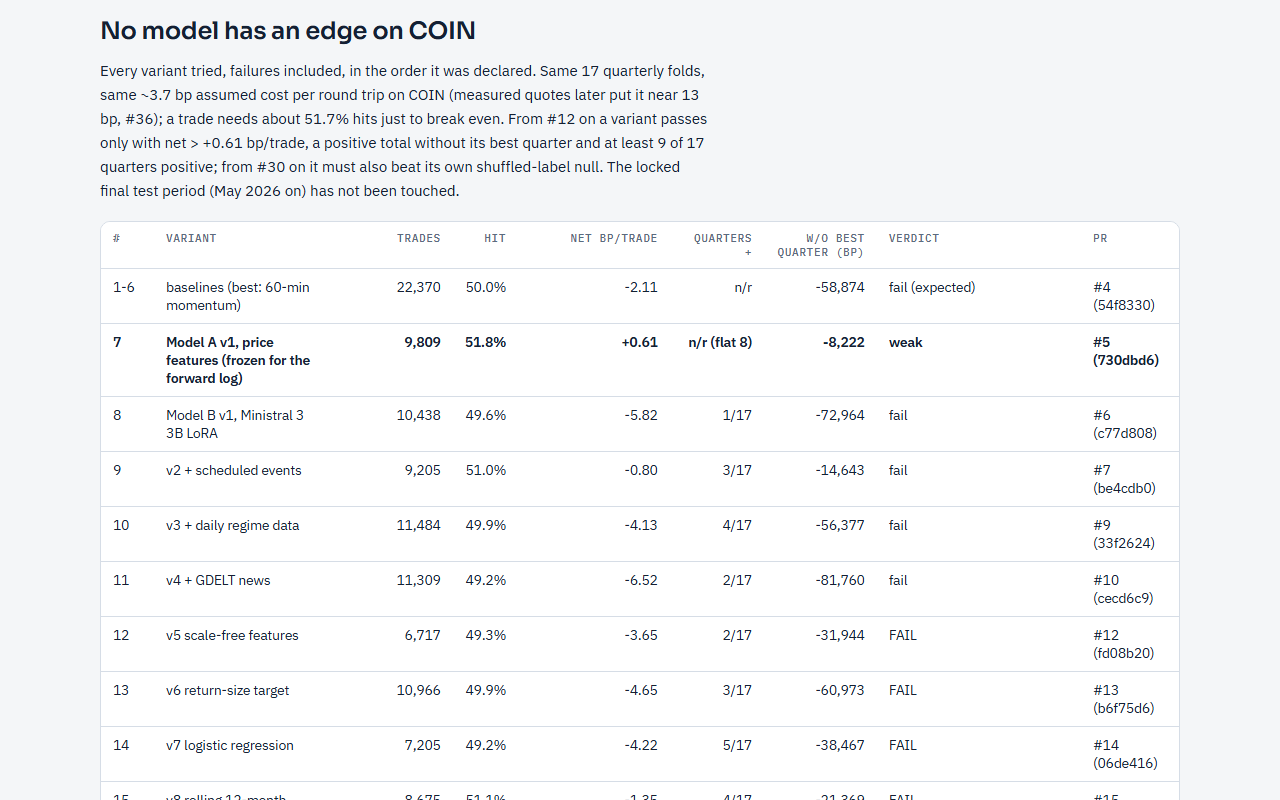
| Variant | Trades | Hit rate | Net bp | Verdict |
|---|---|---|---|---|
| Model A v1 (price features) | 9,809 | 51.8% | +0.61 | Weak: one quarter carried it |
| Model A v1, averaged over 5 seeds | n/a | n/a | −3.09 | Fail: v1 was seed luck |
| Model B, 3B LoRA | 10,438 | 49.6% | −5.82 | Fail |
| Model B, 14B LoRA (17.8 h run) | 2,610 | 49.8% | −5.14 | Fail |
| Shuffled labels, best of 25 | n/a | n/a | +2.69 | Noise, for reference |
- 35 model variants scored. None passed its bar.
- The best Model A run made +0.61 bp per trade, but without its single best quarter it lost 8,222 bp. Pure noise (shuffled labels) reached +2.69 bp, above every COIN variant.
- Model B's training loss stayed at a coin flip. It mostly learned one direction per year, and simply taking that direction every time did slightly better than the model.
- Measured quotes put COIN's real round-trip cost near 13 bp, not the 3.7 bp I first assumed. At that cost a model needs a 54 to 56.5% hit rate to break even; the best any variant reached was 52.9%.
05What I learned
The most useful thing I built wasn't a model. It was the set of checks that kept me from believing a lucky result.
- Average over seeds before believing anything. My best early result vanished when I did.
- Measure costs; don't assume them. My cost assumption was off by more than three times.
- A bigger model doesn't fix weak inputs. 4.7 times the parameters read the same snapshots no better.
- Writing the pass bar down first made it easy to stop. Training is paused on both tracks.
06Links
The repository is private: it holds market data licensed for personal use. Happy to walk through the code on a call.
Revision: 25 November 2026. A frozen model keeps logging paper calls until 200 trades or 21 May 2027.